Spring 2026 Syllabus for Metals in Biology: Emerging Quantitative Methods in Inorganic Physiology
1 Credit (half semester): MGI 991 Section 306/CEM 913 Section 301
2 Credit (full semester): MGI 991 Section 001/CEM 913 Section 002
(registration needed in only one of the above Sections)
Instructors: Dr. Tom O’Halloran, ohallor8@msu.edu; Dr. Keith MacRenaris, macrenar@msu.edu; Dr. Aaron Sue, sueaaron@msu.edu
When: Spring 2026, Meeting Time: Thursdays, 10:20 AM- 12:20 PM
Where: Interdisciplinary Science and Technology Building (ISTB, 766 Service Road) Room 1404
To Register: For 1 credit – MGI 991, Section 306; CEM 913, Section 301. For 2 credits – MGI 991, Section 001; CEM 913, Section 002.
Credits: 1 or 2 Grading: Point Scale
Target Audience: Graduate and senior undergraduate students in MGI, Chemistry, BMS, CMB, Plant Biology, CMIB, EEB, etc.
Enrollment: Capped at 12-15 due to laboratory space constraints
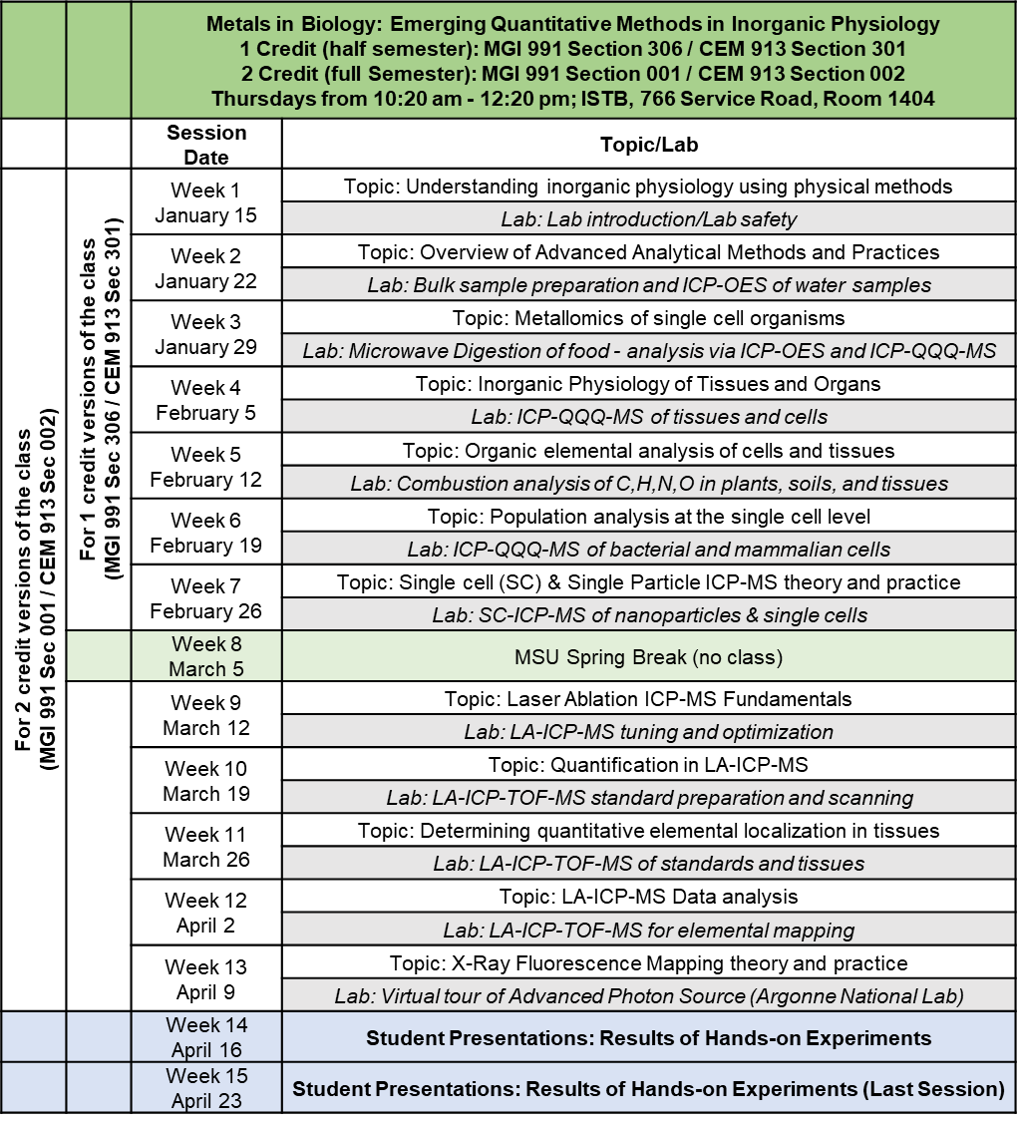
Course Description: In this two-credit graduate course, we will explore applications of emerging quantitative methods in the field of inorganic physiology. The physical science component of course will focus on quantitative methods for determination of elemental content and localization at the subcellular, cellular, and organismal level. Graduate students in physical and life sciences research groups will work in teams to understand how to measure quantitative inorganic phenotypes with the long-term goal of using these kinds of experimental approaches to uncover fundamental molecular mechanisms in biological systems. Case studies of inorganic regulatory networks will include examples form the areas of developmental biology, microbial metal homeostasis, metal dysregulation in host-pathogen interactions as well as monogenic diseases such as Wilson’s disease and hemochromatosis. Metal trafficking in plant biology and the consequences of heavy metals in the environment will also be addressed. Students will learn how to acquire and interpret quantitative elemental data in biological samples using ICP-OES, ICP-QQQ-MS, combustion analysis, laser ablation inductively coupled plasma time-of-flight mass spectroscopy (LA-ICP-TOF-MS) and synchrotron-based X-ray fluorescence (XRF). Nano secondary ion mass spectrometry (SIMS), data analysis, statistical treatments and the use of clustering and assorted algorithms will be addressed.
Course Goals: Using both lectures and hands-on laboratory training with state-of-the-art instrumentation, the overarching goals are to learn how to use quantitative element content and localization to answer mechanistic questions in biological systems.
Structure: One 2-hour lecture/lab session per week. Sessions will typically begin in the lecture hall and then move to the QBEAM laboratories. Students will work in teams during hands-on laboratory sessions using new microwave digestor, combustion analysis systems (for C, H, N), ICP-OES (S, P, F etc.), ICP-QQQ-MS, and both Single Particle (SP) as well as Laser Ablation (LA) ICP-TOF-MS instrumentation. Students are invited to bring samples of interest from their thesis research, otherwise samples will be provided. Lab sessions in the second half of the semester are devoted to data acquisition, analysis, visualization, and team presentations. Postdocs and faculty are welcome to audit.
Grading:Grading will be points based in equal parts on attendance, class participation, an oral PowerPoint presentation to the class and feedback for each student presentation. All students are required to attend and participate in the last two sessions.
Spartan Code of Behavior: All students enrolled in this course must abide by the Spartan Code of Honor. For more details, see honorcode.msu.edu.
Special Assistance: Any students requiring special assistance should identify themselves to the instructor at the beginning of the semester.
Safety and Security: Our classroom is open to the public; however we will spend much of our time in the lab, which is keycard access only. Please take a moment to review general safety tips, emergency actions and preparedness, and classroom safety, and other safety and security information outlined by the MSU Department of Police and Public Safety: https://dpps.msu.edu/safety-tools/safety-tips.
MSU Mandatory Reporting Policy:Michigan State University is committed to fostering a culture of caring and respect that is free of relationship violence and sexual misconduct, and to ensuring that all affected individuals have access to services. For information on reporting options, confidential advocacy and support resources, university policies and procedures, or how to make a difference on campus, visit the Title IX website at titleix.msu.edu.
Limits to confidentiality: As course instructors, we must report the following information to other University offices (including the Department of Police and Public Safety) if you share it with us: suspected child abuse/neglect, even if this maltreatment happened when you were a child; allegations of sexual assault, relationship violence, stalking, or sexual harassment; and credible threats of harm to oneself or to others. These reports may trigger contact from a campus official who will want to talk with you about the incident that you have shared. In almost all cases, it will be your decision whether you wish to speak with that individual. If you would like to talk about these events in a more confidential setting, you are encouraged to make an appointment with MSU Counseling and Psychiatric Services (caps.msu.edu).
Emergency Response: Please familiarize yourself with the location of the nearest evacuation route. If an emergency arises in this classroom, building or vicinity, the faculty will inform you of actions to follow for your safety and for an orderly evacuation. Typically, classes will restart 20 minutes after an all-clear is given by the police.